
How to Choose the Right Payment Ecosystem for Your Business
Equipo Tilopay · 5 de agosto de 2025
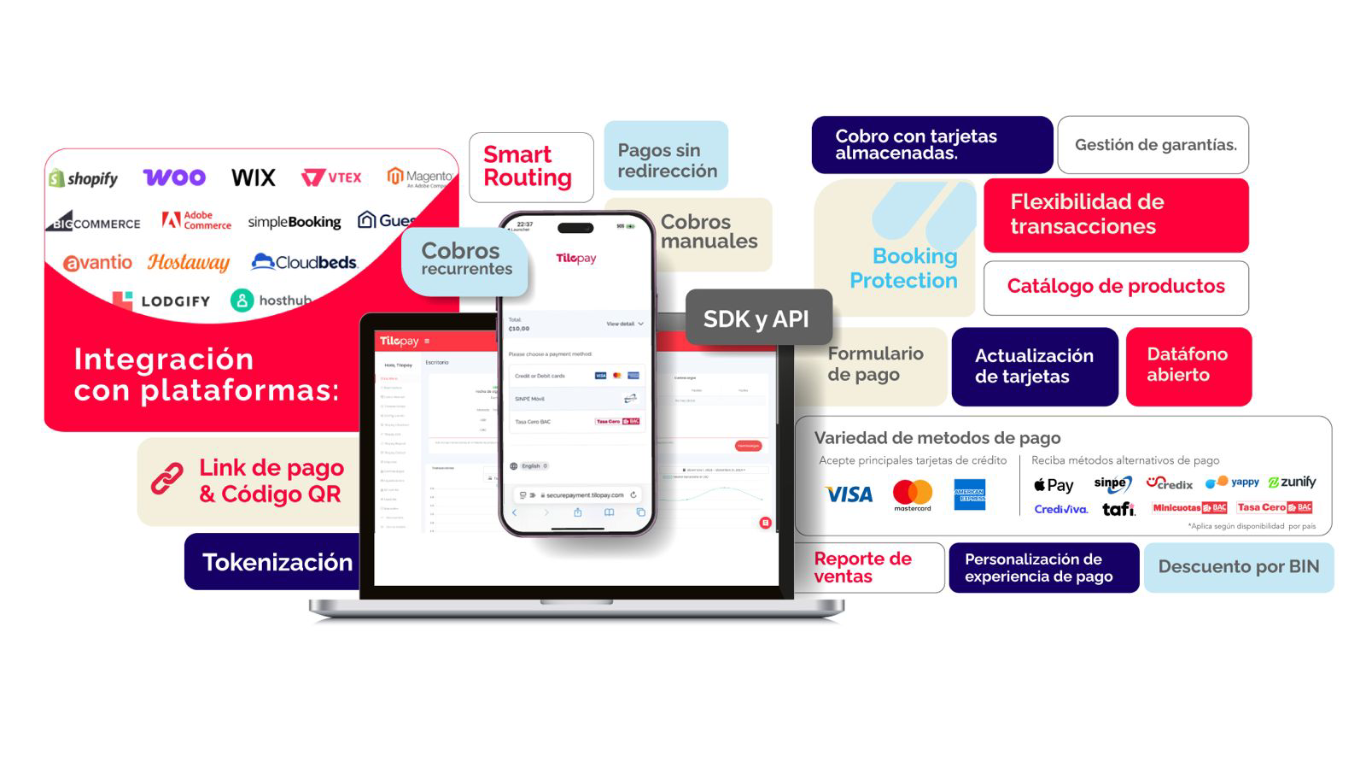
Choosing between standalone tools and a complete payment ecosystem can shape your business’s growth. This guide helps you decide.
Business owners and entrepreneurs in Central America face a critical decision: build their payment infrastructure piece by piece or implement a complete ecosystem that evolves with their business.
This guide gives you a framework for evaluating the type of solution you really need based on your industry, market, and growth goals.
<< Fast, secure, hassle-free online payments for your business >>
What makes the difference: standalone tools vs. an integrated ecosystem
The reality of fragmented solutions
Many entrepreneurs start with the mindset, “I need to process payments,” and end up with a collection of disconnected tools:
- A gateway for international cards
- A separate integration for local payment methods
- A standalone billing system
- Reports across multiple platforms
- Inventory management disconnected from sales
The hidden cost: It’s not just the integration time. It’s the operational complexity that grows exponentially with every additional tool.
The value proposition of an ecosystem
A true ecosystem connects every part of your business operation:
- Product and service management
- Omnichannel payment processing
- Unified reporting and business intelligence
- Integrated operational tools
- Automated protection and compliance
The real value: Each component enhances the effectiveness of the others, creating efficiencies that wouldn’t exist with separate tools.
Industry assessment: what your business really needs
Hospitality and tourism: beyond basic payment processing
Industry-specific challenges:
- Managing reservations with deposits and outstanding balances
- Cancellation policies that vary by season
- Managing multiple currencies for international tourism
- Protection against no-shows and disputes
- Reporting tailored to seasonal cycles
Ecosystem value for hospitality:
An integrated ecosystem allows reservations, payments, inventory management (rooms/services), and reporting to work as a unified system. When a guest cancels, the system automatically releases inventory, processes refunds based on predefined policies, and updates revenue forecasts.
Signs you need a complete ecosystem:
- You manage more than 50 reservations per month
- You operate in multiple countries or serve international tourists
- You need detailed reporting for seasonal planning
- You need to automate complex cancellation policies
Retail and e-commerce: unifying sales channels
The complexities of modern retail:
- Inventory synchronized between physical and online stores
- In-person and remote payments through the same system
- Returns and warranty management
- Omnichannel purchasing behavior analysis
- Discount codes and loyalty programs
Ecosystem value for retail:
The power lies in unification. A customer can reserve online and pay in-store, or make an in-person purchase and receive recurring invoices for additional services. Inventory updates automatically, reports consolidate every channel, and promotions apply consistently.
Signs you need a complete ecosystem:
- You operate both online and in person
- You manage inventory for more than 100 products
- You offer after-sales services or subscriptions
- You need detailed customer behavior analysis
Professional services: automating the client-provider relationship
Unique challenges for services:
- Billing by the hour vs. by project vs. by retainer
- Recurring charges with monthly variations
- Contract management and automatic renewals
- Time and profitability reporting by client
- Managing international payments for remote clients
Ecosystem value for services:
An ecosystem allows logged time to be converted automatically into invoices, contracts to generate recurring charges, and reports to show true profitability by client based on time, costs, and payment methods used.
Signs you need a complete ecosystem:
- You manage more than 20 active clients
- You offer recurring services or long-term contracts
- You need detailed profitability reporting
- You need to automate renewals and charges
Decision framework: evaluating ecosystem options
Essential technical criteria
1. Native integration capabilities
- Does it connect directly to your existing platforms?
- Does it require significant custom development?
- Are integrations kept up to date automatically?
2. True scalability
- Can it handle volume increases without reconfiguration?
- Do costs scale linearly, or are there pricing thresholds?
- Can you add new payment methods without changing your infrastructure?
3. Operational intelligence
- Does it provide insights you couldn’t get from separate tools?
- Do reports connect data from different areas of your business?
- Does it offer automatic optimizations based on usage patterns?
Critical business criteria
1. Regional fit
- Does it understand the specific characteristics of Central American markets?
- Does it adapt to local regulations and preferences?
- Does it evolve as regional payment methods change?
2. Specialized support
- Does the support team understand your specific industry?
- Do they operate in your time zone and language?
- Can they help with strategic optimizations, not just technical issues?
3. Transparent pricing model
- Are costs predictable as you grow?
- Are there hidden fees that appear as your volume increases?
- Does ROI improve as you use more ecosystem features?
ROI analysis: calculating the true value of an ecosystem
Visible costs vs. hidden costs
Fragmented tools—hidden costs:
- Development time for integrations (40–80 hours per integration)
- Maintaining multiple vendor relationships
- Manual report reconciliation
- Debugging issues between systems
- Training your team on multiple platforms
Integrated ecosystem—visible investment:
- Higher but predictable initial setup costs
- A single, focused learning curve
- Simplified maintenance
- Unified support
Practical value calculator
To evaluate an ecosystem’s ROI:
- Calculate how much time you currently spend managing payments:
- Weekly hours spent reconciling reports
- Time spent resolving technical issues
- Managing relationships with multiple providers
- Project the ecosystem’s efficiencies:
- Reduced operational time (typically 60–80%)
- Higher conversion rates from an optimized checkout
- Fewer errors through automation
- Compare total costs:
- Don’t look only at transaction fees
- Include your team’s time and missed opportunities
- Consider the value of additional insights
Common mistakes to avoid
Mistake #1: Focusing only on transaction costs
Transaction fees are only one part of the total cost. An ecosystem with slightly higher fees can deliver a higher ROI through operational efficiencies.
Mistake #2: Underestimating integration costs
Each additional integration requires not only upfront time but also ongoing maintenance. An ecosystem reduces this overhead exponentially.
Mistake #3: Not considering scalability from the start
What works for 100 monthly transactions can break down at 10,000. A well-designed ecosystem scales automatically.
Mistake #4: Ignoring your team’s learning curve
Multiple tools require multiple training sessions. A unified ecosystem helps your team become proficient faster.
Your strategic decision
Choosing between fragmented tools and an integrated ecosystem defines not only how you process payments, but also how you run your business. A well-chosen ecosystem becomes a competitive advantage that improves over time, while fragmented tools tend to create more complexity as you grow.
The question isn’t whether you need to process payments—that’s a basic requirement. The question is whether you want your payment infrastructure to actively drive business growth or simply “work.”
A true ecosystem evolves with you, learns from your business patterns, and automatically optimizes for your specific goals. In Central America, where markets change quickly and regional opportunities are enormous, having the right infrastructure isn’t an advantage—it’s a strategic necessity.
The ecosystem decision you make today will determine how efficiently you can scale tomorrow.